
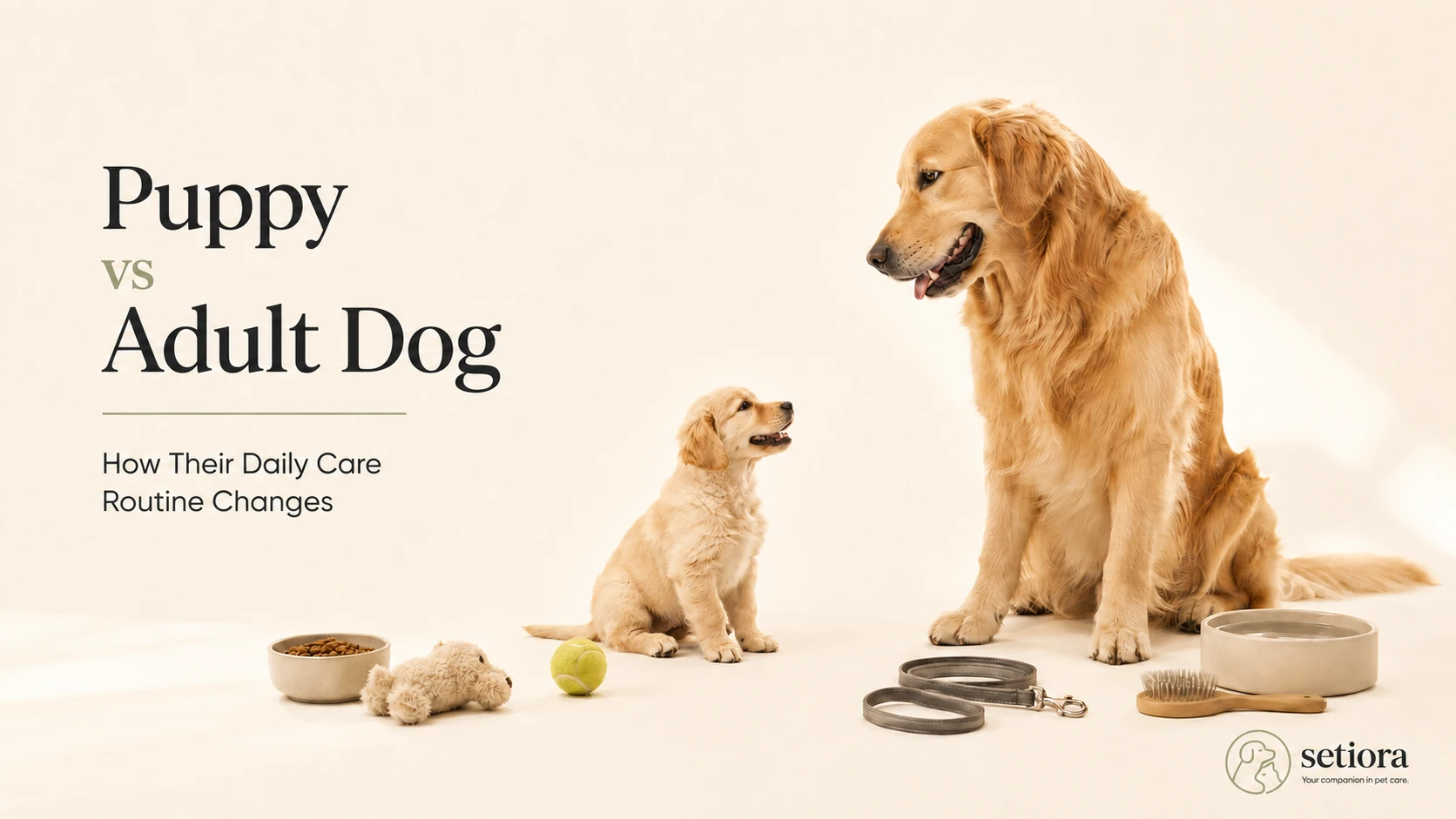
Many new owners assume dogs need the same care throughout their lives. In reality, almost every routine changes as a puppy grows into an adult — from meals and exercise to vet visits and mental stimulation. Understanding those changes helps your dog stay healthier while making daily care easier for you.
Quick Comparison
| Care Area | Puppy | Adult Dog |
|---|---|---|
| Feeding | 3–4 meals/day | 1–2 meals/day |
| Exercise | Short, frequent sessions | Longer, sustained walks |
| Sleep | 16–20 hrs/day | 12–14 hrs/day |
| Training | Daily basics | Reinforcement |
| Vet visits | Frequent (every 3–4 weeks) | Annual, or as advised |
| Vaccinations | Initial series | Boosters |
| Grooming | Gentle introduction | Regular maintenance |
| Socialization | Critical window | Ongoing exposure |
1. Feeding
Puppies have small stomachs and fast metabolisms, so they need smaller, more frequent meals — typically 3–4 times a day up to around 6 months old. As growth slows, most adult dogs do well on 1–2 meals daily.
- Frequency: Puppies need more frequent meals to support steady blood sugar and growth; adults can go longer between meals.
- Portion size: Portions should track your vet's growth charts for puppies, then shift to a maintenance amount that keeps an adult dog at a healthy weight.
- Growth nutrition: Puppy food is formulated with higher protein, fat, and calcium for development — switching to adult food too early can leave gaps in growing bones and joints.
- Water: Fresh water should always be available at every life stage, but puppies dehydrate faster and need more frequent access, especially after play.
2. Exercise
Puppies and adult dogs need very different amounts and types of activity.
- Don't over-exercise puppies. Too much high-impact activity too early can stress developing joints.
- Growth plates. Per AAHA Canine Life Stage Guidelines, a puppy's growth plates don't fully close until roughly 12–18 months (later in large breeds), so repetitive jumping or long runs should wait until then.
- Adult endurance. Once fully grown, most dogs can handle longer walks, runs, and more sustained play.
- Breed differences. A Border Collie and a Bulldog have very different exercise ceilings at every age — tailor intensity to your dog's breed and build, not just their age.
3. Sleep
Sleep needs drop significantly as dogs mature.
- How much puppies sleep. Puppies sleep 16–20 hours a day — growth and brain development happen largely during rest.
- Signs of overtired puppies. Nipping, zoomies, and sudden crankiness often mean a puppy needs a nap, not more stimulation.
- Adult sleep patterns. Adult dogs settle into a more predictable 12–14 hours a day, often synced to the household's schedule.
4. Training
Training doesn't stop once the basics are down — it just changes shape.
- House training and crate training are foundational in the first few months and set lifelong habits.
- Basic commands (sit, stay, come, leave it) are best introduced early and repeated often.
- Adult refreshers keep commands sharp and reinforce good behavior as distractions and independence increase.
- Mental enrichment — puzzle feeders, scent games, new tricks — matters just as much for adult dogs as it did as a puppy.
5. Socialization
Socialization is one of the biggest differences between puppy and adult care. Per the American College of Veterinary Behaviorists (ACVB), the critical window for puppies — roughly 3 to 14 weeks — is when they're most receptive to new people, animals, sounds, and environments without developing fear responses. Missing this window doesn't mean an adult dog can't adapt, but it typically takes more patience and gradual exposure. Adult dogs still benefit from ongoing socialization to stay confident and well-adjusted, just at a steadier pace.
6. Veterinary Care
Vet care is front-loaded in the first year, then settles into a maintenance rhythm.
- Vaccination schedule. Puppies need a series of core vaccines starting around 6–8 weeks, with boosters every 3–4 weeks until 16 weeks. See our complete puppy vaccination schedule for exact timing.
- Deworming. Puppies are typically dewormed every 2–3 weeks until 12 weeks old, then on a reduced adult schedule.
- Routine exams. Frequent puppy checkups track growth and catch issues early; adult dogs generally move to annual exams.
- Preventive care. Flea, tick, and heartworm prevention should run continuously at every age, adjusted for weight as your dog grows.
7. Grooming
Grooming habits should start early and evolve as coat, nails, and teeth mature.
- Brushing frequency depends on coat type but should start young so puppies get comfortable with handling.
- Bathing should be occasional for puppies (over-bathing dries out developing skin) and can be more regular for adults depending on lifestyle.
- Nail trimming needs to start early to avoid overgrowth and get puppies used to paw handling.
- Dental care should begin as soon as adult teeth come in — early habits prevent painful buildup later.
- Ear cleaning matters at every stage, especially for floppy-eared breeds prone to infection.
8. Health Monitoring
What you watch for shifts as your dog ages.
- Weight and growth should be tracked against breed-specific curves for puppies, then monitored for stability in adults.
- Behaviour changes — new aggression, withdrawal, or restlessness — can signal pain or stress at any age.
- Appetite and energy dips are often the earliest signs something is wrong, especially in adult dogs who otherwise seem fine.
- Early warning signs like limping, excessive thirst, or changes in bathroom habits deserve a vet visit regardless of age. Our guide on common signs your pet is hiding pain covers subtle symptoms owners often miss.
9. Common Mistakes
- Walking puppies too far, too soon, before joints are ready
- Switching food too quickly, causing digestive upset
- Skipping training once the "cute puppy" phase ends
- Ignoring dental care until it becomes a costly problem
- Assuming adult dogs need less mental stimulation than puppies
Final Takeaway
Every stage of your dog's life brings different needs. Adjusting feeding, exercise, training, and vet care over time helps prevent health problems, supports good behavior, and makes caring for your companion much easier. For a broader view of what to expect at each life stage, check out our pet health timeline.
Whether you're caring for a playful puppy or a calm adult dog, keeping feeding schedules, health records, grooming, and vet reminders organized in one place can make staying consistent much easier — that's exactly what Setiora is built for.
Sources
Developmental timing above reflects guidance from:
Individual dogs and breeds vary — check growth, exercise, and socialization plans with your veterinarian.
Not veterinary advice
This article is for general educational purposes only and isn't a substitute for individualized guidance from a licensed veterinarian. Always consult your vet before starting, changing, or stopping any vaccination, medication, or treatment for your pet, and seek immediate veterinary or emergency care for urgent symptoms.
Track your pet's health with Setiora
Log vaccinations, medications, weight, and vet visits — all offline, all organised.
Join Waitlist →