
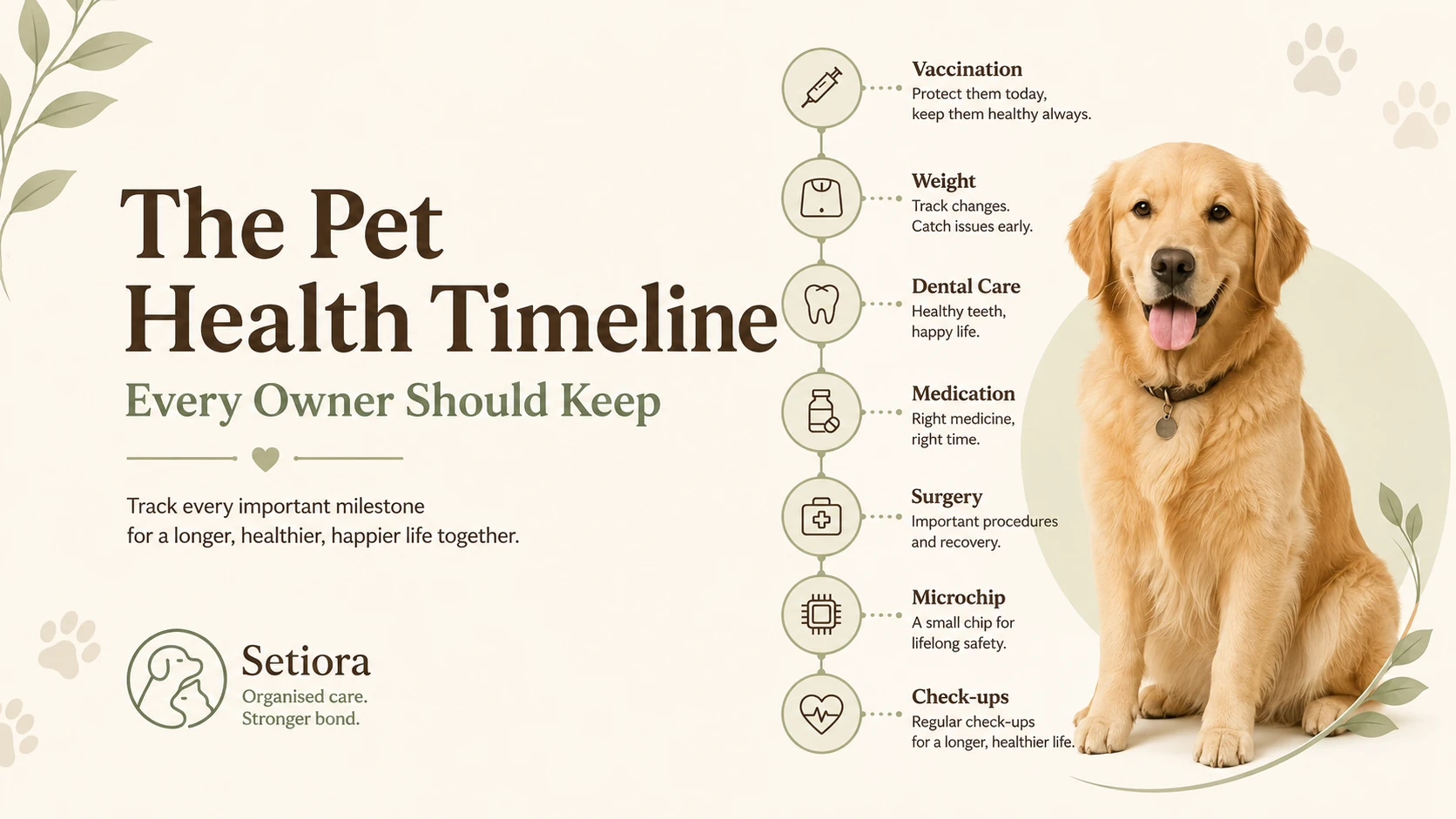
Most pet owners remember the important moments — the first vaccination, the surgery that went well, the medication that finally worked.
Until they're suddenly asked for them.
A vet asks, "When was the last vaccination?" — and you're scrolling through old photos, searching WhatsApp messages, or trying to remember which clinic you visited two years ago.
Your pet's medical history shouldn't rely on memory. The good news is that keeping it organised is far simpler than it sounds. A pet health timeline is just one place where every record lives, in order, from the day you brought your pet home.
Why a Health Timeline Matters
A scattered health history feels manageable — right up until the moment it doesn't.
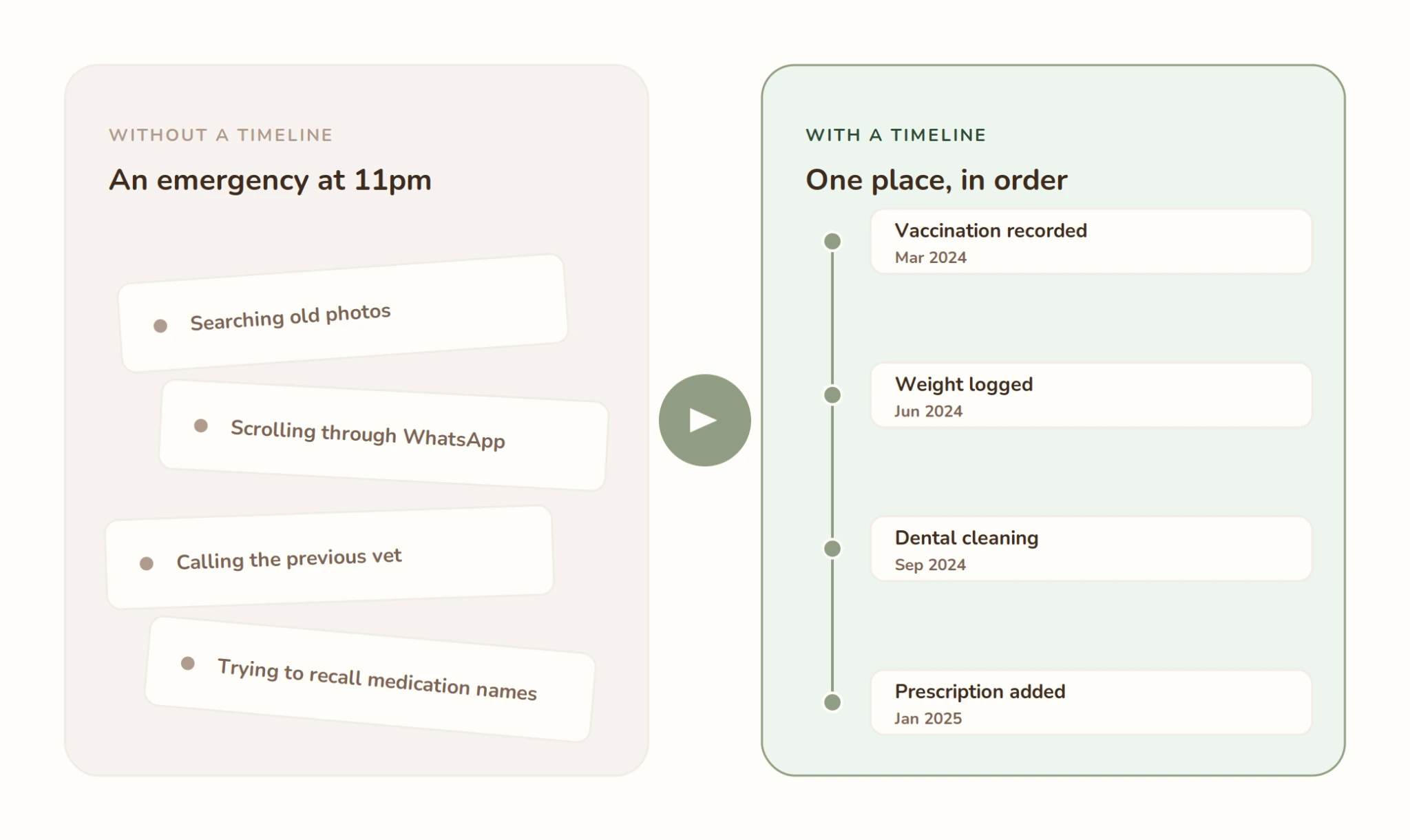
Without a timeline, an emergency means searching. With one, everything is already in order.
A single, organised timeline pays off exactly when the stakes are highest:
- Emergencies — At 11pm on a weekend, an emergency vet needs your pet's history fast. There's no time to call around for records.
- Changing vets — A new clinic can only pick up where the last one left off if the history travels with your pet.
- Travelling — Domestic boarding and international travel both require proof of vaccinations and health status.
- Insurance — Claims move faster, and pre-existing conditions are far easier to prove, when dates and diagnoses are documented.
- Aging pets — Senior pets need more frequent monitoring, and small trends over time become important clues.
- Chronic illnesses — Conditions like diabetes or kidney disease are managed with data: weights, doses, and how symptoms change month to month.
A timeline turns "I think it was around last spring?" into a clear, confident answer.
What Every Timeline Should Include
This is the heart of your pet's timeline. Each item below covers why it matters, when you'll need it, and what to record.
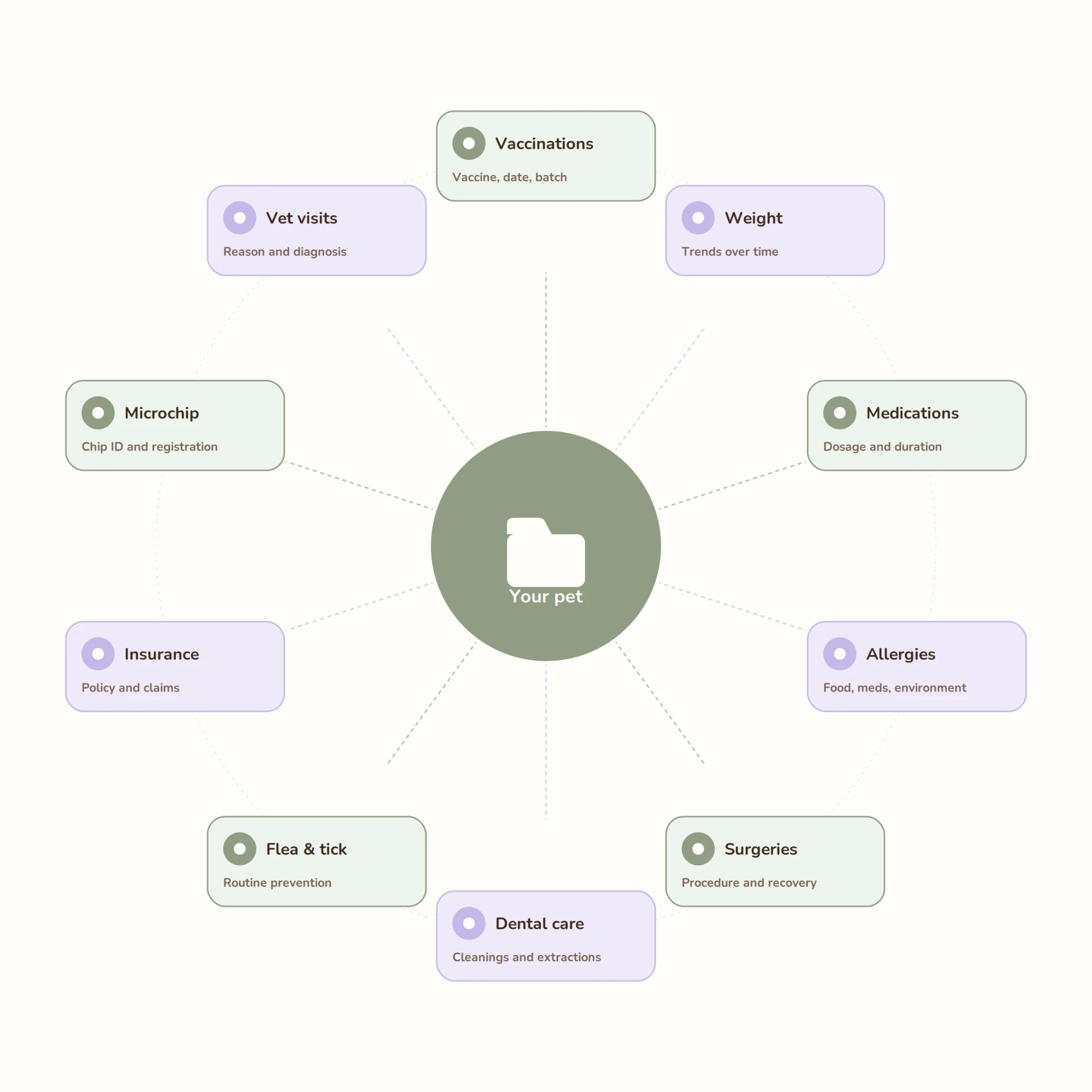
Every record connects back to a single source of truth — your pet.
Vaccinations
Why it matters: Vaccinations are the most frequently requested record of all, and proof is often required before boarding, grooming, or any procedure.
When you'll need it: Boarding, travel, a new vet, or after a bite incident.
What to record:
- Vaccine name
- Date given
- Batch number
- Veterinarian
- Next due date
Medications
Why it matters: Guessing a name or dose during an emergency risks dangerous interactions. A clear list removes that risk.
When you'll need it: Any new prescription, an emergency visit, or a switch in vets.
What to record:
- Medicine name
- Dosage
- Duration
- Reason prescribed
- Any side effects
Allergies
Why it matters: This is one of the most critical records to keep. An unknown allergy can complicate — or endanger — emergency treatment.
When you'll need it: Before any new food, medication, or procedure.
What to record:
- Food allergies
- Medication allergies
- Environmental triggers
- Reaction severity
Weight History
Why it matters: Weight is one of the most overlooked indicators of health. Trends often reveal problems long before visible symptoms appear.
When you'll need it: Every check-up, and any time appetite or energy changes.
What to record:
- Weight
- Date measured
- Body condition notes
Surgeries
Why it matters: A documented surgical history helps any future vet understand what your pet has already been through.
When you'll need it: New diagnoses, second opinions, or related follow-up care.
What to record:
- Date
- Procedure
- Recovery notes
- Hospital or clinic
- Related documents
Dental Care
Why it matters: Oral health affects the whole body, and dental problems are easy to miss until they become painful.
When you'll need it: Routine cleanings and whenever eating habits change.
What to record:
- Cleanings
- Tooth extractions
- Signs of oral disease
- Next dental check
Flea, Tick & Deworming
Why it matters: These are so routine that many owners forget them entirely — until a gap in prevention causes a problem.
When you'll need it: Every treatment cycle and before travel.
What to record:
- Product used
- Date given
- Next due date
Insurance
Why it matters: When a vet is waiting on payment approval, having your policy details ready speeds up treatment.
When you'll need it: Any claim or emergency.
What to record:
- Policy number
- Renewal date
- Claim number
- Emergency contacts
Microchip
Why it matters: Many owners know their pet is chipped but not the actual number or registry — which is exactly what reunites you if your pet goes missing.
When you'll need it: If your pet is lost, or after a move.
What to record:
- Chip ID
- Registration provider
- Registration status
- Emergency contact
Vet Visits
Why it matters: A running record of visits is arguably more valuable than any single document — it's the story of your pet's health over time.
When you'll need it: Every appointment, and whenever a new vet needs context.
What to record:
- Reason for visit
- Diagnosis
- Treatment
- Follow-up
A Timeline Isn't Just for Emergencies
It's easy to think of a health timeline as an emergency tool. In reality, it earns its keep in ordinary, everyday situations too:
- Moving to another city and finding a new clinic
- Changing vets without losing years of history
- Travelling internationally, where documentation is mandatory
- Pet sitting, so a sitter knows medications and routines
- Boarding, where vaccination proof is required
- A family member caring for your pet while you're away
In each case, a complete history means less guesswork and better care — no matter who's looking after your pet.
Paper vs Digital
Paper isn't the enemy — plenty of great timelines start in a notebook. But it's worth being honest about the trade-offs.
| Paper | Digital |
|---|---|
| Easy to misplace | Searchable |
| Hard to update | Always current |
| Spread across folders | One timeline |
| No reminders | Due-date reminders |
| Difficult to share | Easy during emergencies |
The right choice is whichever one you'll actually keep up to date. For many owners, digital wins simply because reminders and sharing remove the friction that causes records to fall behind.
Build Your Timeline Today
You don't need to do this all at once. Start with what you have, and fill in the rest over time. Here's the full checklist:
- Vaccinations
- Medications
- Allergies
- Weight
- Surgeries
- Insurance
- Microchip
- Vet visits
- Dental care
- Flea & tick treatments
If you'd like a more detailed starting point, our ultimate pet health record checklist breaks down every record worth keeping, and the pet emergency folder checklist covers what to have ready for the worst-case moments.
Frequently Asked Questions
What should a pet health timeline include?
At a minimum: vaccinations, medications, allergies, weight history, surgeries, dental care, flea and tick treatments, insurance, microchip details, and a running log of vet visits. Together these give any veterinarian a complete picture of your pet's health.
How far back should my pet's health records go?
Ideally to the day you got your pet, or as far back as records exist. Early vaccinations, surgeries, and chronic conditions can all become relevant years later, so it's worth recovering older records from previous clinics when you can.
Is a digital pet health record better than paper?
Both work, but digital records are searchable, easy to share in an emergency, and can send due-date reminders. Paper works without power or signal. Many owners keep a digital timeline as their main record and a printed copy as a backup.
Why is tracking my pet's weight so important?
Weight trends often reveal health problems — such as kidney disease, diabetes, or dental pain — before any visible symptoms appear. Regular measurements make gradual changes easy to spot.
How do I move my pet's records to a new vet?
Ask your current clinic for copies of vaccinations, test results, and treatment history. Keeping your own timeline makes this transfer far easier, since you already hold the complete history yourself.
Conclusion
Whether you use a notebook, a spreadsheet, or a dedicated pet care app, the important thing is keeping your pet's history together in one place. When every record lives in a single timeline, routine check-ups become easier and emergencies become far less stressful.
Setiora is one way to keep that timeline in a single place — vaccinations, medications, allergies, weight, surgeries, and vet visits all in order, with due-date reminders so nothing slips past you. However you choose to do it, your pet's history deserves better than memory.
Not veterinary advice
This article is for general educational purposes only and isn't a substitute for individualized guidance from a licensed veterinarian. Always consult your vet before starting, changing, or stopping any vaccination, medication, or treatment for your pet, and seek immediate veterinary or emergency care for urgent symptoms.
Track your pet's health with Setiora
Log vaccinations, medications, weight, and vet visits — all offline, all organised.
Join Waitlist →